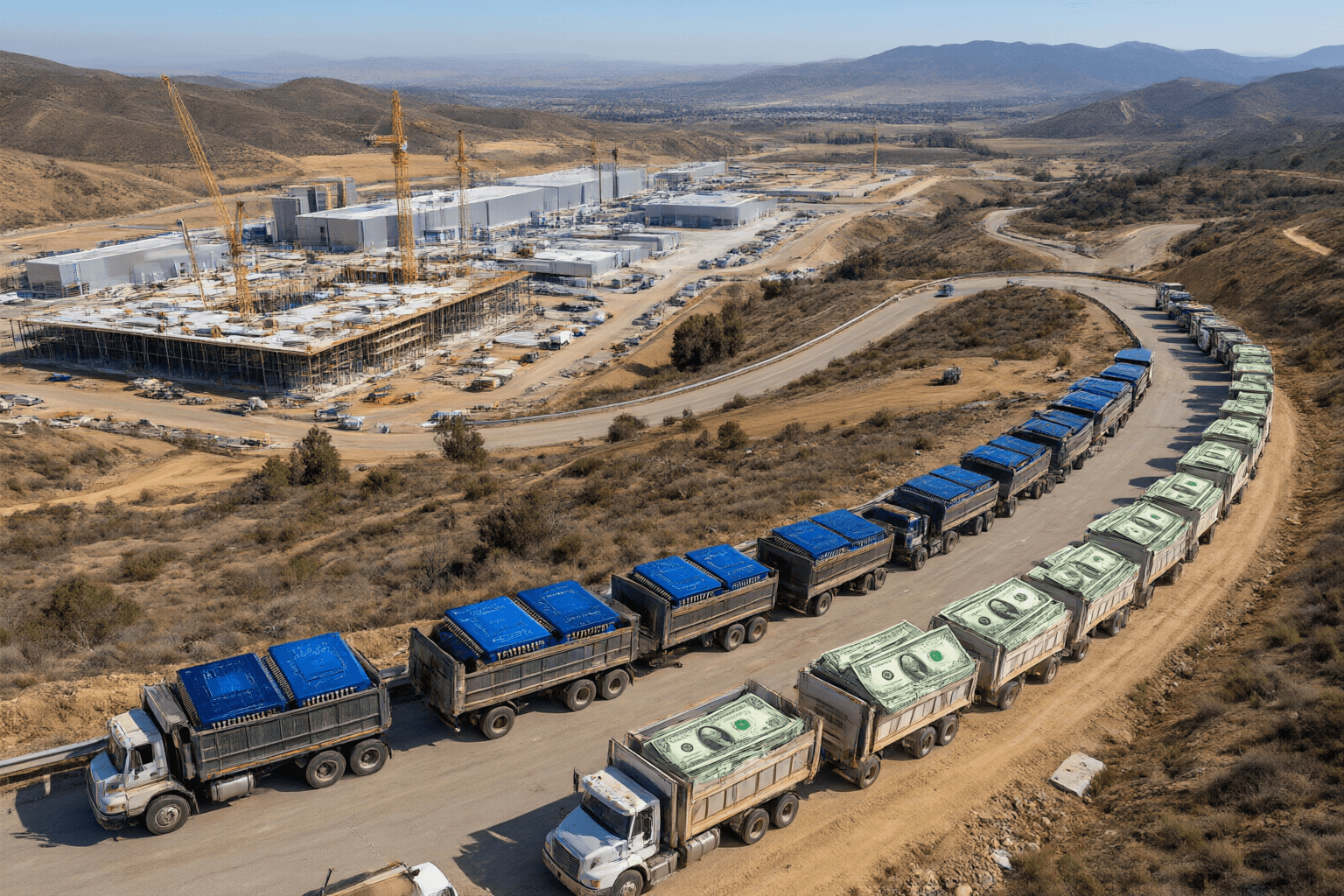
Five companies that sell the silicon of the AI buildout — NVIDIA, TSMC, Micron, SK Hynix and Samsung — were worth ~$11 trillion in late October 2026 (aggregators span $10.5–11.5T, depending on the SK Hynix and TSMC prints); Broadcom (~$1.7T) and the electrical suppliers push the complex past $12.5T. We asked what those valuations require, using only arithmetic: the consensus capex path, margins anchored by history, and a discount rate. The answer is a growth rate. The cleanest version of the calculation — NVIDIA alone, total earnings against total market value — discounts its entire future cash flow to ~$1.9T against a $5.2T price, and the gap resolves to an implied perpetual growth rate of 6.9% nominal (7.2% at today's risk-free rate). The same exercise on the whole complex lands in a 5–8% band. Every version is above the semiconductor industry's own long-run growth rate of 3.91% a year.
The AI debate is stuck on demand — will the revenue come? That question is currently unwinnable. This piece steps around it. We grant the demand case in full: the ~$850B of 2026 hyperscaler capex is spent, the path to $1.4 trillion completes, every gigawatt sells out. Then we ask the only question left for a rational investor: what do the shovel makers earn when the buildout matures, and what must that profit do afterward to justify today's price?



Discussion